Health and wellbeing are complicated matters. The list of factors that may influence them is long, with social and economic circumstances being far from its bottom. It is well established that people from disadvantaged subgroups of the population are more prone to diseases and unhealthy ageing, especially now, under the ongoing economic crisis.
The burden of non-communicable diseases like cancer or cardiovascular diseases is becoming more and more relevant. Cancer cases are expected to rise from 14 million in 2012 to almost 22 million by 2030. However, our understanding of these health threats is changing significantly, with the rise of a new conceptual framework that could help us to develop new health strategies.
One of the main new concepts is that early-life exposures have long-term consequences. This is related to the representation of health as a trajectory, more than a static status. A dynamic conceptualization that better describe life and ageing as continuous processes, made up by two main stages: the build-up phase and the decline phase (Figure 1). The former begins at conception and ends at late adolescence, and is an extremely sensitive periods, both biologically and socially. Being exposed to low socioeconomic circumstances in this stage may negatively impact the maximum attained health. A maximum that is slowly eroded during the decline stage, starting in early adulthood. And again, socioeconomic status (SES) is a strong determinant of the rate of such decline.
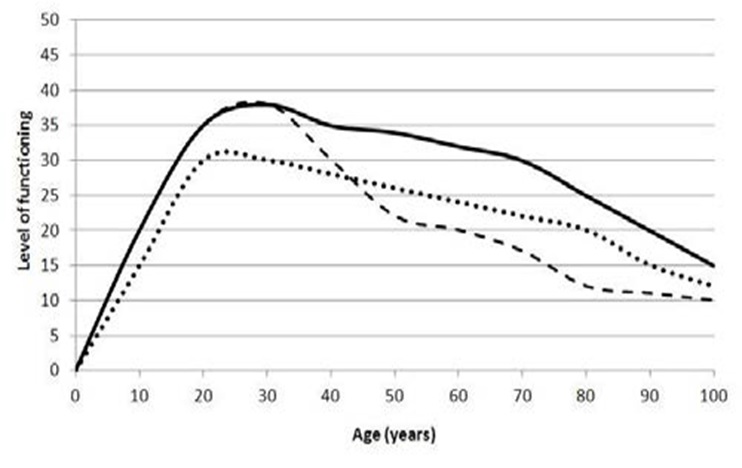
Figure 1: The graph represents life course growth and decline in functioning according to the Strachan-Sheikh Model, with the “build-up” and the “decline” stages. Social exposures during the first stage can influence the proportion of optimum growth attained, (dotted line). Social exposures during the second stage can influence the rate at which functioning is lost (dashed line).
By combining biology, anthropology, social sciences, medicine and demography, scientists have begun to unravel the biological mechanisms underlying the influence of SES on health and ageing. A recent example comes from a paper published on the International Journal of Epidemiology by a research group led by Paolo Vineis and Silvia Stringhini. The researchers described the evidence they found of some biological embedding of socioeconomic status. They analysed a group of less than a thousand participants drawn from a large general Italian population cohort made up of about 520,000 individuals, integrating molecular analysis performed on blood samples with lifestyle and SES data, which were quantified by using specific indicators.
In particular, individuals’ lifestyle was assessed trough self-administered questionnaires that focus on some particular traits: smoking status, physical activity, diet, alcohol intake, age, sex and disease status. As for their socioeconomic status, two markers were combined to draw life-course socioeconomic trajectories: household’s highest occupational position and father’s occupational position. To investigate the biological underpinnings of these traits, the researchers focused their attention on a set of genes known to be involved in SES-related inflammation. Low socioeconomic status in humans has been associated with increased inflammatory activity, as well as with a higher cortisol production during the day and higher blood level of antibodies for several pathogens. Indeed, all clues pointing to a dampened immune response.
In the end, the results of the study suggested that low SES is associated with variations in epigenetics markers in peripheral blood cells, which may potentially exacerbate inflammatory response. According to the author, in the long term this could lead to the development of chronic diseases like breast or colon cancer.
The author of the study have recently joined forces with other research team in Europe and US to launch LIFEPATH, an EU-funded project whose aim is to investigate the biological pathways underlying social differences in healthy ageing. Health is socially and biologically constructed since the earliest moments of life. Thus, unravelling the dynamics behind this constant building up may be of great help to better take care of our health, not only as individuals but as an integrated community.
References
Strachan D, Sheikh A. A life course approach to respiratory and allergic diseases. In D. Kuh & Y. Ben-Shlomo. (Eds). A Life Course Approach to Chronic Disease Epidemiology, 2nd edition (2004: pp. 240-259). Oxford: Oxford University Press.
Vineis P, Kelly-Irving M, Rappaport S, Stringhini S. The biological embedding of social differences in ageing trajectories. J Epidemiol Community Health. 2015 Aug 7.
Stringhini S, Polidoro S, Sacerdote C, Kelly RS, van Veldhoven K, Agnoli C, Grioni S, Tumino R, Giurdanella MC, Panico S, Mattiello A, Palli D, Masala G, Gallo V, Castagné R, Paccaud F, Campanella G, Chadeau-Hyam M, Vineis P. Life-course socioeconomic status and DNA methylation of genes regulating inflammation. Int J Epidemiol. 2015 Aug;44(4):1320-30.
Bray F, Jemal A, Torre LA, Forman D, Vineis P. Long-term Realism and Cost-effectiveness: Primary Prevention in Combatting Cancer and Associated Inequalities Worldwide. J Natl Cancer Inst. 2015 Sep 30;107(12).