First published in Research Europe (http://info.researchprofessional.com/research-europe/), 17 May 2018.
The great and the good of Italian science met in Rome last week, but politicians were nowhere to be seen.
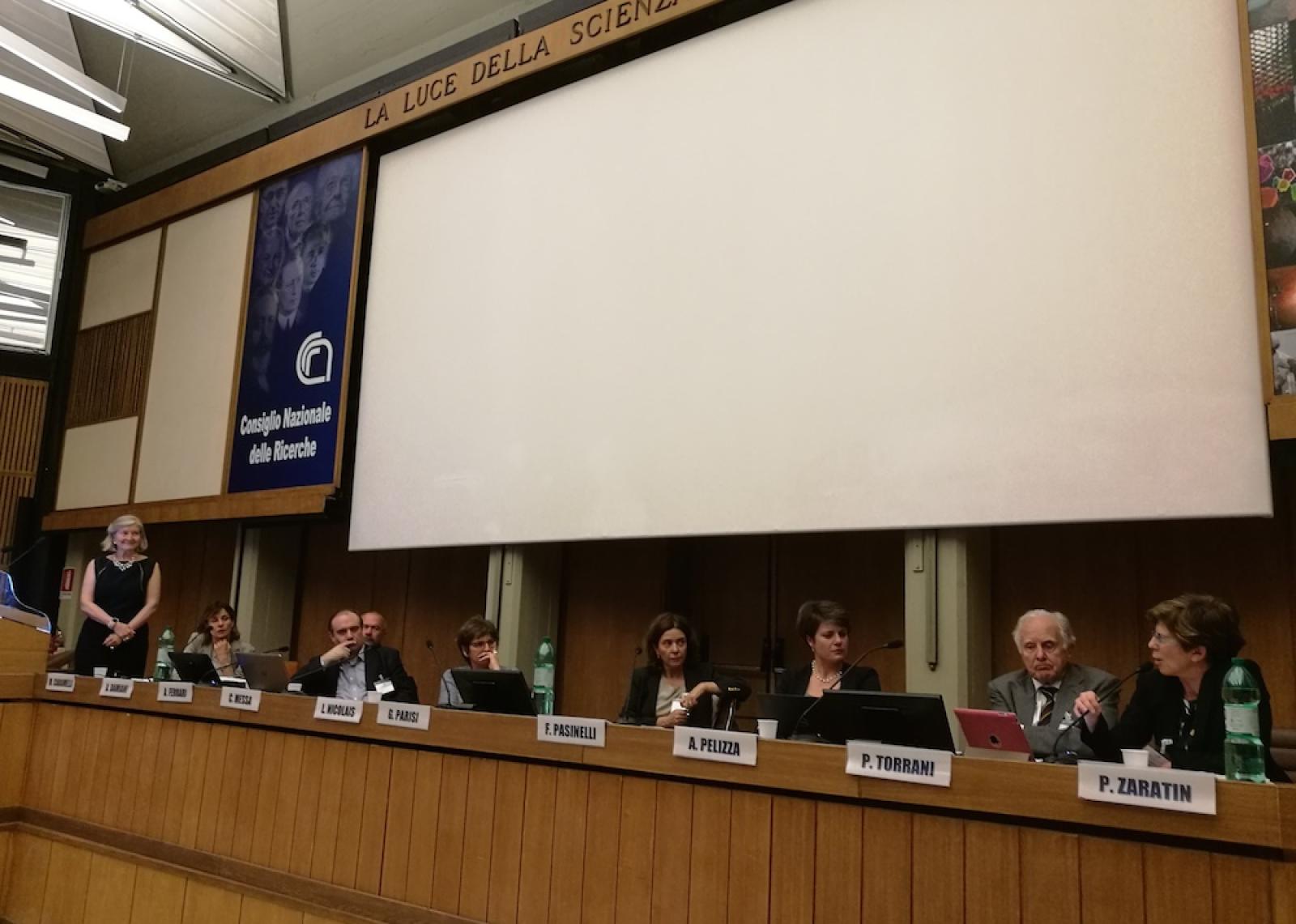
"Scientific research: value for the country" as the topic of discussion at a conference taking place at the national research council would sound self-evident in many parts of Europe. But the social value of research and innovation is still far from obvious in today’s Italy. Among the dozens of experts convened at the meeting of the Gruppy 2003, a group of highly cited researchers, not one was representing the government, and no member of the parliament, past or newly elected, showed up, not even in the audience of some 150 people.
The meeting, held on 10 May at the CNR’s headquarters in Rome, comes in the midst of difficult coalition building by the government. This may have kept many political figures busy that day. But the meeting left an aftertaste, a vision of a scientific community steering by sight, without a grand plan. Researchers were just getting on with the job, left to themselves.
The only sign of appreciation came from Italy’s President of the Republic Sergio Mattarella who awarded a special medal to the event’s organisers to highlight their hard work. Sadly, the gesture also drew attention to the rarity of a one-day gathering of top-level figures to discuss the country’s plans for science policy, or lack thereof.
Economist Mario Pianta, from the Università di Roma Tre, opened the meeting by describing the general picture of Italian science, based on a report by the EU’s Joint Research Centre, published in April. Simply put, most Italian universities and research institutions are suffering from the protracted austerity, with only the area between Milan and Bologna resisting well. Pianta also cited a report on competitiveness just published by Italian statistical institute ISTAT, which showed that the government plan Industria 4.0 has so far been unable to spark private investments. Despite many generous fiscal incentives, private spending on research increased only by 0.1 per cent, favouring big business in northern Italy.
Many of those at the meeting blamed a lack of consistent ex-post evaluation of research spending for the weakness of R&D spending. Without proper evaluation, funders do not know which research has succeeded and are reluctant to invest again, they said. The Italian government focuses instead on evaluating projects before they take place, which can delay funding and penalise researchers for bureaucratic reasons.
“The system is based on distrust between the public administration and academics,” said Luigi Nicolais, former president of CNR and of the Gruppo 2003. “Public servants know that they will risk being sanctioned if their ex-ante evaluation is challenged, while there is no similar interest in ex-post evaluation,” he said.
The result is regular paralysis within the research system, with projects hanging in uncertainty for months, often until private partners get fed up. “The current rules of the public administration are incompatible with innovation,” said Francesca Pasinelli, director-general of the charity Telethon.
The other huge hurdle is the irregular and unpredictable availability of public funding, which makes the long-term planning of projects impossible. Pier Giuseppe Torrani, president of the Italian Association for Research on Cancer, said it is unacceptable that many researchers do not know in advance when public calls will be launched, what their content will be and how long the selection will take.
Considering this scenario, the European Research Area represents both an opportunity and a steep challenge. Italy wants to remain attractive, and possibly become more attractive for top researchers, but the unpredictability of funding and policy make this difficult. Luca Moretti, from the CNR office in Brussels, blamed the lack of a selective national strategy for slow European investments in research.
“Germany has six priorities, while Italy has 12 clusters,” he told the audience, saying that this was just one example of framework conditions as being conductive, or not, to science. The Italian situation is exacerbated by the dearth of training opportunities to help researchers win EU funding, the conference heard. In his Brussels office, Moretti said, he still receives calls from people who would like to see their own research funded, but have no clue of how the EU funding system works. “We need an efficient system for supporting and backing researchers,” he said.
“Italy’s research system needs to innovate, because we need to provide young researchers with some certainties about their future,” said Cristina Messa, rector of the Università di Milano-Bicocca. “But this requires undergoing change. Researchers must accept the idea of being evaluated in a new context, where responsible research implies understanding the needs of citizens and of the society.”
Messa also praised the proposal of establishing a national agency for research, for many years the main goal of Gruppo 2003. But she said that this must have an efficient system of political governance and involve academics from the start.
A case in point would be the launch of a government-backed foundation for the promotion of research and technology transfer on the same day as the event. Messa spoke of her “surprise and dismay” at having been completely clueless about this new foundation. “Many among us first heard about this by reading today’s newspapers,” she said.