Article published on the ASSET website
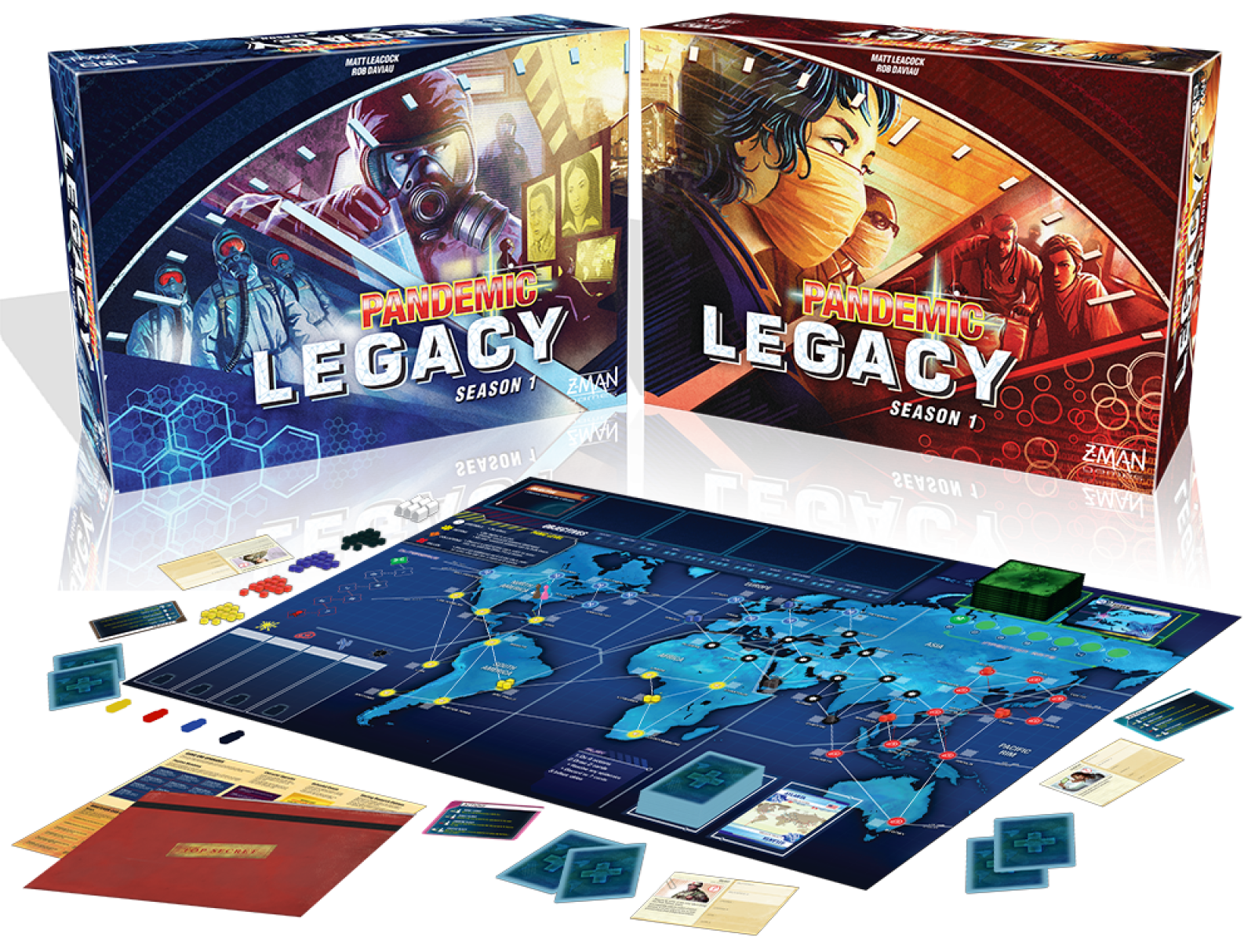
Month by month, the diseases spread across the world, cities fall into panic and some of them are even wiped out by virulent outbreaks, while tenacious experts cooperate to find a cure before it’s too late. This is not the plot of one of those end-of-the-world movies that Hollywood loves, but a scenario that everybody can experience by playing Pandemic Legacy, a board game released at the end of 2015 that quickly rose in ranking on the BoardGameGeek websites, the biggest online database for tabletop games, finally getting to the top. That of Pandemic is not a new brand for board games enthusiasts, since the first edition of the game was published in 2007.
“At the time when I created the first version of the game, there were a lot of pandemic in the news”, told us its creator, Matt Leacock, a former user experience designer who became a full time game designer in 2014. “I was working on the game concept and I wanted to come up with an enemy that the players can all agree is bad and must be stopped. And pandemics perfectly fit into my idea”.
Pandemic is a cooperative game where players take the roles of experts with different specialisations, whose task is to find the cure for the four diseases that are swiping the globe. At the same time, they will also need to contain the spread of these diseases, in order to avoid outbreaks and chain reactions that could trigger more outbreaks and thus leading to a defeat. A simple and effective card-driven mechanic dictates where and how fast the four pathogens propagate. “At the beginning I thought I could make a kind of educational game, adding text and information on the cards”, explained Leacock. “But then I changed my mind and decided to focus more on emotions, since they are more engaging than facts”. And the emotional approach works, for Pandemic conveys a sense of pressure, hurry and emergency that effectively reflects the fight against time to halt the spreading infectious diseases. Most of all, it absolutely requires players to coordinate themselves in order to win.
The game was an immediate success and, in the following years, spawned a series of expansionsand spinoffs, of which Pandemic Legacy is the last and most successful one. Its idea is simple: the core mechanics of the game are integrated within the Legacy system, developed by Rob Daviau. Legacy games are board games that physically change over time based on the outcome of each match and the various choices made by players: cards are destroyed, secret boxes are opened and stickers are added to the board. Permanently. There’s no turning back. In Pandemic Legacy, players embark in a yearlong campaign against the four diseases, each game representing a month of such struggle. And after each game, something happens that will influence the following ones. As the story develops, new scenarios unfold and new mechanics are introduced, forcing players to face new challenges and to carefully plan all their actions, for they may have unpredictable consequences.
Pandemic Legacy won four golden geek awards in 2015, including best board game of the year, best strategy game, most innovative game and best thematic game, and the Pandemic series in general achieved great success. Not only amongst board gamers, but also amongst experts in medicine, communication and teaching.
“Even if I abandoned the idea of making an educational game, I got a pretty good feedback from the scientific community about the way the game simulated reality”, said Leacock. There are many notable examples of such a recognition. One of the most striking came from Robert Keegan, who has used the game in a project he started at the University of Leicester Medical School. His aim was to address a very difficult and important problem in medical education: teaching teamwork and communication. He prepared interactive sessions where students in groups of four played Pandemicwhilst being observed by a tutor who was trained in using specific criteria of teamwork. Once feedback was completed, students had a few minutes break before playing a second game, again observed. This allowed for direct recording of the impact of teamwork and communication teaching.
Using games for educational purpose is not something new; serious games have been around since the Sixties and, in the last decade, an increasing number of them has been produced. However, serious games are specifically designed for purposes other than pure entertainment (like healthcare, defence, education, communication, politics), whilst a game like Pandemic is primarily conceived to engage and entertain players. But, while doing that, it also manages to teach something, not by being didactic but by leading players into an immersive experience, allowing them to delve into their roles and the complexity of a critical situation, where only through collaboration they may achieve victory. And this may represent a very powerful tool for health and risk communication. Sherline Lee, a CDC epidemiologist who works in the Healthcare Preparedness Activity program, wrote about the game on her blog on the CDC website, praising it for how well it reflected the reality and values of public health, especially for its focus on cooperation between different expertises, which is a key element in public health response.