It happened again: after the Israeli case, Horizon 2020 is anew in the middle of a political clash. This time the situation is even worse than the Israel one, both because it is within the European geographical region and because Switzerland had been a key player in the previous Seventh Framework Program. Roughly, the question is: is it fair towards EU citizens that European institutions that are based on the “free movement of persons and ideas” gives their moneys to a Country that refuted this ideal? On the Swiss side, traditionally the referendums are strong and powerful tools to bind political decisions to citizens' will. For that reason, the February 9th Referendum is a non-returning point. On the European Union side, otherwise, it is a matter of giving money (a lot of money) to a country that is refuting the freedom of movements of its citizens. This is a clear case of diplomatic fight, an intricate but meaningful example of how science and diplomacy are strictly linked.
From EU-Swiss agreements to the Switzerland performance in 7FP
As been part of the EFTA, the free trade area of the European continent (an organization backed by the US to support European integration), during the 90s Switzerland had signed ten bilateral agreements with the European Union. Two agreements deal respectively with the free movement of citizens and the access of the Swiss research institutions to European grants. On these bases, Switzerland entered enthusiastically the Seventh Framework Program, with great performances (see figures above, in the infographics). A negotiations session for the participation of Switzerland in the Horizon 2020 and Erasmus+ programs had been scheduled for mid-February, but then, after the Referendum, almost frozen.
The referendum “against mass immigration”
Out of doubt, and despite political considerations, Switzerland is part of the European scientific community. As shown by the infographics, many scientific researchers working in Switzerland are not Swiss nationals: for this reason they couldn't vote for the Referendum about migration policy in the Confederation. Briefly, the Referendum, called “Popular initiative against Mass Immigration” was backed by the Swiss People's Party, and gained success particularly in the Ticino canton. The Referendum has passed with 50.3% of positive votes, underlining strong differences between the Cantons and, mainly, between the ruling class – which endorsed a rejection of the Referendum – and the majority of the Swiss population. The referendum imposed quota on immigration into the Confederation borders, with no distinction for what purpose the migration is aimed, such as work, study, research or humanitarian. No one can say what will be the real effects of this decision, as Swiss economy and culture are strongly linked with the rest of Europe. Great concerns are based on a clause of the referendum stating that “international treaties opposite to this article cannot be signed... International treaties that contradict Article 121a should be renegotiated and adjusted within three years after the adoption of this article”.
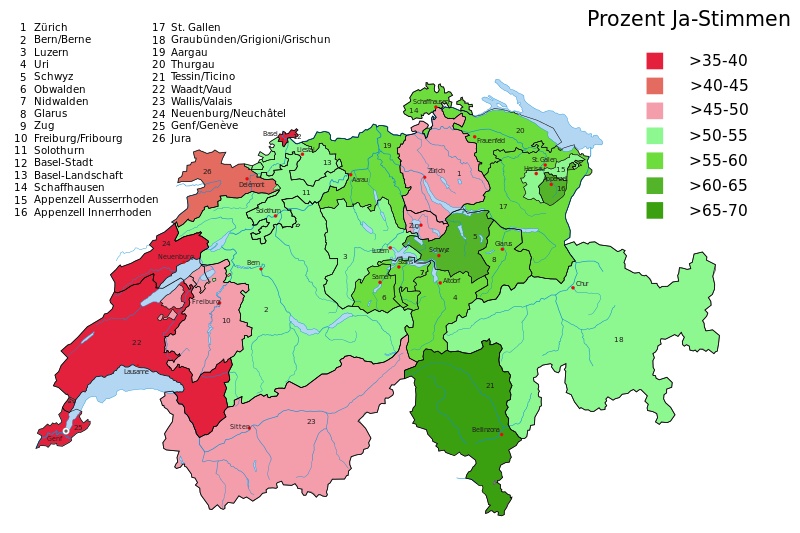
(source)
The Croatian issue
Due to these two clauses, Swiss authorities couldn't widen the free circulation agreement to the newly entered Member State of the European Union, Croatia. This had been taken by the EU institutions as the first practical results of the validity of the referendum. The EU has immediately frozen all the negotiations with the Swiss Confederation, including those relating to H2020 and Erasmus+. Anyway, insiders said that “the EU legislative machine and deal-making with Switzerland will continue on the institutional framework as normal until the Swiss government puts forward its anti-EU migrant bill”. And they were right.
What will happen
On February 25th, the Swiss State Secretariat for Education Research and Innovation announced that an agreement had been concluded with the EU. The result is that the Confederation will be considered as a third country in applying for Horizon 2020 calls. This means that “researchers in Switzerland may continue to take part in partnership projects [but they are] no longer able to take part in individual projects due to its third country status”. Meanwhile, a group of European scientists promoted a petition to stop this political clash (and the results of the referendum).