Good news for the small and medium enterprises (SMEs) that aim to bring their own scientific research at an international level. The Ministry of Education and Research has officially committed to fund and support Italian participants in Eurostars-2, with a budget of 0.5 million euro in grants and 2 million euro in loans, in order to develop new ideas as part of the action taken under Article 185 of the Treaty on the Functioning of the European Union (TFEU). Which means funds with a better rate than that proposed by the actual market.
TFEU aims to integrate parts of national programs in order to build a common European research program. Eurostars is an European programme that supports research-performing SMEs for the development of innovative products, processes and services that should be rapidly commercialized. The European Community has funded Eurostars-2 with 287 million euro for the period between 2014 and 2020, requiring the member states a funding at least three times higher. Hence the commitment of the Ministry of Education to invest a total amount of 2.5 million euro in this second phase of the project (the Ministry of Education did not participate to the first deadline, last March).
Therefore, Eurostars-2 is the last link in a long chain of initiatives for the construction of a European network for research, an international coordination in view of Horizon 2020. The main link of the chain is represented by EUREKA, an international initiative launched in 1985 to promote and support scientific and industrial research through the creation of R&D projects. Eurostars-2 is coordinated by EUREKA, as happened for Eurostars in 2013. In this occasion, the Ministry of Education had planned a total funding of 4.2 million euro (1.5 million euro contribution to the expenditure and 2.7 per subsidized credit). Public actors – universities and research institutes – were only given a contribution to the cost, while private entities were funded with both a contribution to the costs and a subsidized loan. In addition, Eurostars-2 has the bottom-up approach and all the typical characteristics of EUREKA projects. There are not privileged or excluded areas, except for military applications.
There are two specific requirements for SMEs that want to apply; they are financial criteria, calculated using the data reported in the last approved balance sheet:
- the net assets of the enterprise must be greater than half of the difference between the sum of the costs of all the projects for which public funding has been requested by the participant during the year, and the sum of the contributions received, approved or requested for the same projects;
- the quotient between financial charges and turnover of the enterprise must be less than 8 percent.
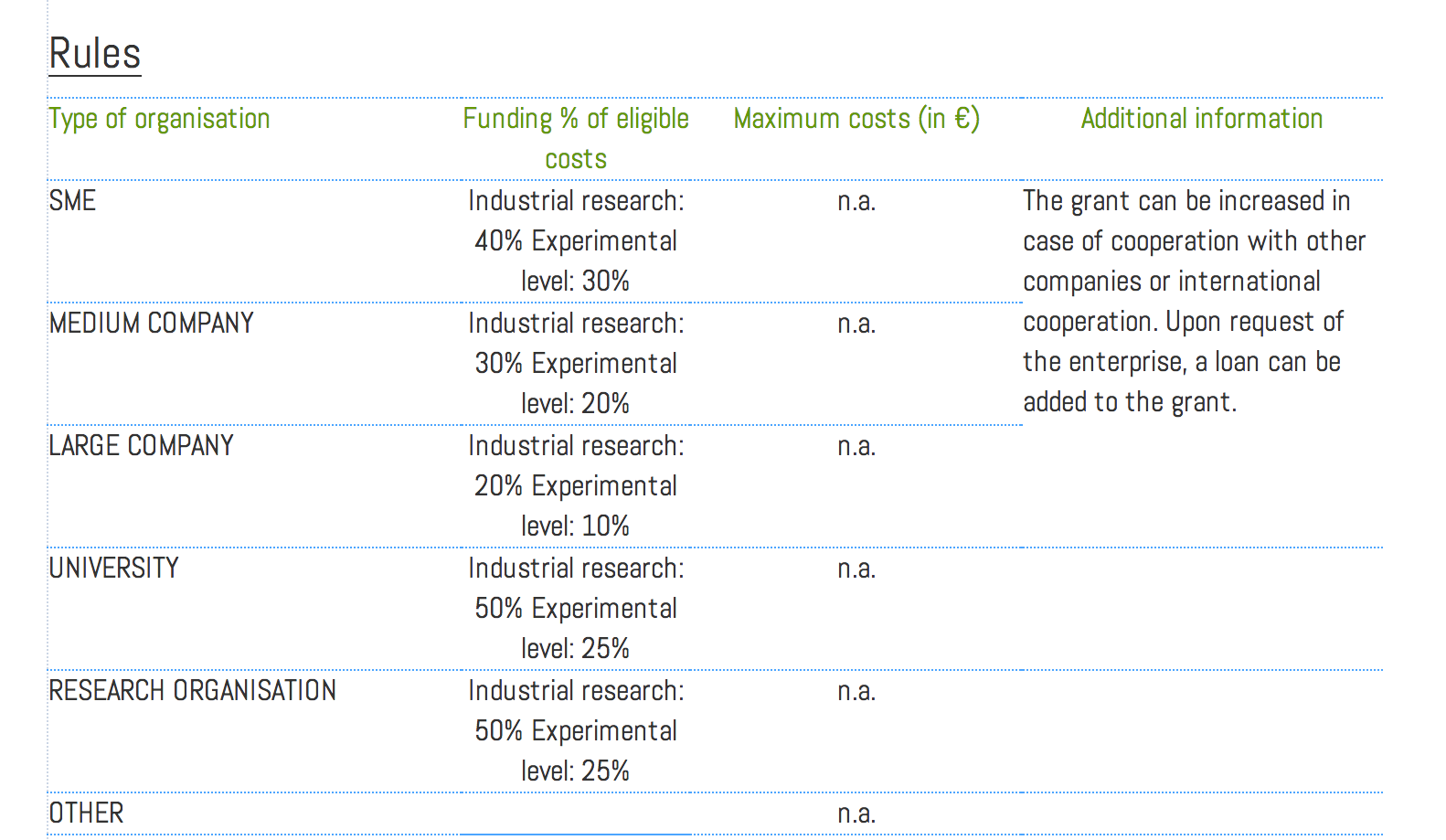
Finally, concerning the percentage funding of eligible costs, it depends on the dimension of the enterprise/research centre, as can be seen in the table below.
Thus, we just have to wait for the outcome of the selection procedures that expired on September 11th and see which new Italian projects will benefit from these funds, anything but small.