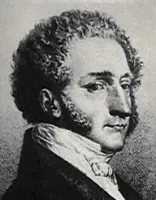
Bartolomeo Panizza (Vicenza, 1785 - Pavia, 1867) earned his Surgery degree from Padua in 1806 and later his Medical degree from Pavia. He established Italy’s first microscopic anatomy course in the Lombard city. Panizza was a distinguished physiologist recognized for clarifying that veins play the dominant role in absorption (previously thought exclusive to lymphatic vessels) and for investigating various cranial nerves, particularly those involved in vision. He was among the first to locate the occipital lobe as the cortical region responsible for sight. He conducted comparative anatomy research, especially studying the lymphatic system in reptiles. Camillo Golgi counted him as a mentor. Beyond science, Panizza served as a health officer accompanying Napoleon’s troops to Russia in 1814, where he was captured. He later became a Senator of the Italian Kingdom.
In his 1855 work “Osservazioni sul nervo ottico,” Panizza “traced the visual projection from the optic nerve to brain structures, establishing that the posterior cortex is the vision center.” His contemporaries largely overlooked this finding, requiring years before proper recognition.