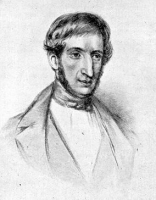
Ottaviano Fabrizio Mossotti (Novara, 1791 – Pisa, 1863) was an influential physicist and astronomer during the Risorgimento period. He studied at the University of Pavia under Vincenzo Brunacci, earning degrees in Mathematics and Physics in 1811. As a student of Alessandro Volta, he later worked at the Brera Observatory, developing new methods for calculating celestial body orbits based on four observed points. His approximative method gained attention from Carl Friedrich Gauss, establishing his reputation across Europe.
Politically liberal, he collaborated with Il Conciliatore. He allegedly affiliated with Filippo Buonarroti’s secret society, the Sublimi Maestri Perfetti. Austrian police discovered his name on a contact list, forcing him to leave Milan.
He fled to Switzerland, then England, becoming a member of the Astronomical Society and connecting with Herschel and Babbage. In 1827, he emigrated to Argentina, working at Buenos Aires University as mathematician, physicist, astronomer, meteorologist, and surveyor. By 1835, he moved to Corfu, Greece, briefly visiting Turin before returning to Italy in 1840. The Grand Duke of Tuscany appointed him to teach mathematical physics, celestial mechanics, and geodesy at Pisa University. Enrico Betti numbered among his students.
He participated in the 1840 Second Meeting of Italian Scientists in Turin, which he helped arrange to include Babbage.
His research covered fluid mechanics and elasticity problems. He developed analytical theories of molecular forces and their relationships to electrical and luminous phenomena, proposing that molecular forces stemmed from molecular-ether atom interactions, with repulsive forces at very short distances and attractive forces at greater distances.
Based on this framework, he created a dielectric theory later employed by Rudolf Clausius for mechanical heat theory and by James Clerk Maxwell, who cited him repeatedly. The Clausius-Mossotti equation remains in use today.
He led the Tuscan University Battalion during the First War of Independence, fighting at Curtatone and Montanara in 1848. In 1859, he joined Tuscany’s State Council. On January 20, 1861, he became a Senator of the Kingdom of Italy.
He is regarded as the greatest Italian mathematical physicist of the first half of the nineteenth century.