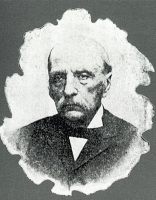
Giustiniano Nicolucci (Isola del Liri, 1819 – Isola del Liri, 1904) was an anthropologist, archaeologist and ethnologist. He is considered one of the founders of modern Italian anthropology.
Born March 12, 1819 in Isola del Liri, in the province of Frosinone, from a wealthy family, he attended the Tullian College of Arpino, studying both classical and scientific subjects. He then moved to Naples to study medicine, graduating in 1845. At the University of Naples he also attended advanced courses in Italian language, ancient classics, philosophy, and foreign languages. Shortly after obtaining his medical degree, he presented the results of physiological research conducted with microscopes at the VII Congress of Italian Scientists, held in Naples that same year.
For family reasons, however, Nicolucci had to return to his native town, leaving research and beginning his medical practice. He continued studying privately. His interests concerned anthropology. Convinced that humanity divided into races, his objective was to arrange them in a detailed genealogical tree. For this he began describing human varieties with the greatest possible detail, using both physiognomic and anthropometric parameters, as well as ethnographic information.
In 1852 he traveled in Europe and contacted numerous foreign scholars involved in anthropology’s development. He thus began organizing a skull collection.
In 1858 he published “Delle razze umane” (On Human Races), which established him among European anthropology’s greats, partly because he proposed a multidisciplinary approach to this new field of study.
With Italian Unification he ran for parliament, was elected and served as deputy until 1865. After his parliamentary term, between 1867 and 1869 he published two important essays, “On the Anthropology of Greece” and “Anthropology of Etruria.” Meanwhile he began occupying himself with paleoanthropology and early stone tools. In 1869, he competed but did not obtain Italy’s first Anthropology professorship established in Florence: Paolo Mantegazza was preferred.
Despite this setback, Nicolucci continued his research, especially in prehistoric archaeology, and in 1880 obtained the Anthropology professorship established for him in Naples, at the Faculty of Medicine and Surgery. In the two following decades his output was notable: he was now a convinced evolutionist and already in 1886 wrote “Anthropology of Italy in Ancient and Modern Times,” examining all peoples whose presence was established in Italy, tracing not only their physical but also cultural profile.
In 1870 he delivered the inaugural address at the first Congress of Prehistoric Archaeology and Anthropology held in Bologna. He became honorary member of the Royal Anthropological Institute of Great Britain and Ireland and was a member of the Accademia dei XL.
In 1881 he founded the Museum of Anthropology in Naples, attached to the Institute of Ethno-Anthropology.
Giustiniano Nicolucci died suddenly in his native Isola del Liri in 1904.