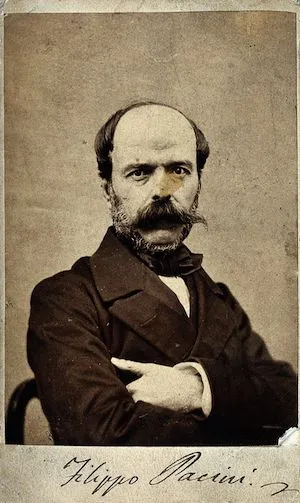
Filippo Pacini (Pistoia, 1812 - Firenze, 1883) was a Tuscan physician born into a poor family in Pistoia. Using a microscope refined by Giovanni Battista Amici in 1835, he discovered corpuscles in the deeper layers of hand, foot, and nipple skin—structures now bearing his name. He presented this finding at the first Meeting of Italian Scientists in Pisa in 1839.
The discovery gained little attention until 1844, when German researchers Henle and Kolliker published detailed descriptions while properly crediting Pacini’s work. Recognition followed in Italy, allowing him to conduct extensive histological studies from Pisa and Florence using microscopy. His research encompassed intercostal muscle mechanics, osmosis processes, and organism absorption.
In 1854, Pacini demonstrated cholera’s contagious nature and identified the vibrio as its pathogenic agent—decades before Koch’s work. Again, his recognition came posthumously.
Pacini also engaged in epistemology, criticizing empiricists for neglecting theory, arguing that science requires “a strong and coherent theoretical apparatus.”
International nomenclature committees only recognized Pacini’s cholera discovery in 1965, 82 years after his death, when they officially adopted “Vibrio cholerae Pacini 1854” as the organism’s correct designation.