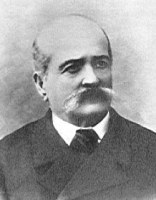
Eusebio Oehl (Lodi, 1827 – Pavia, 1903) was one of the major Italian physiologists of the nineteenth century and a leading figure in Pavia’s school of physiology and histology. Born in Lodi on December 5, 1827, he completed his medical studies at the University of Pavia, graduating in 1850 as a student of Bartolomeo Panizza.
After graduation, Oehl moved to Vienna to study with Joseph Hyrtl at the Institute of Anatomy and Ernst Brucke at the Institute of Physiology. He subsequently studied in Germany, France, and Britain before returning to Pavia in 1858 as a lecturer in histology. The previous year, he published research on microscopic anatomy examining skin and palm epidermis in medical journals.
In 1861, Oehl established the Institute of Physiology and became a full professor of physiology in 1864. That year he published his major scientific work, a memoir on human saliva extraction through salivary duct irrigation. He demonstrated how to collect saliva differentially from three salivary ducts and described how various stimuli produced saliva with different qualities and quantities—establishing that each salivary gland performs specific work.
His stimulus-response research anticipated Ivan Pavlov’s later investigations. Oehl authored numerous physiological studies, including research on muscular fibers and Brownian motion. He wrote a three-volume physiology manual (1868-1876) and a microscopy handbook. As a mentor at Collegio Ghislieri, his students included Camillo Golgi, Giulio Bizzozero, and Enrico Sertoli.